What Is Enterprise RAG and How Does Private LLM Architecture Protect Corporate Data?
Enterprise Retrieval-Augmented Generation (RAG) is an AI system architecture that grounds Large Language Models in verified corporate data repositories (such as documentation, relational databases, and enterprise systems) without retraining the underlying foundation model. By combining semantic vector embeddings, hybrid keyword search, and private LLM inference within a secured Virtual Private Cloud (VPC), organizations eliminate hallucinations while ensuring zero data leakage. Discover how XynSol Workflow & AI Automation Services and Custom Web & Software Development design and implement secure enterprise AI pipelines.
As enterprise organizations move past exploratory generative AI pilots, they encounter three critical roadblocks:
- Hallucination Risk: Foundation models produce factually untruthful responses when queried on proprietary, domain-specific topics.
- Data Privacy & IP Leakage: Routing confidential business records or customer data through multi-tenant public APIs creates severe regulatory and security vulnerabilities.
- Stale Knowledge: Commercial foundation models are static snapshots trained on historical web data, unaware of real-time inventory, pricing revisions, or internal codebases.
To solve these challenges in mission-critical environments, engineering teams must build production-grade Enterprise RAG pipelines paired with private, isolated model inference.
The End-to-End Enterprise RAG Pipeline
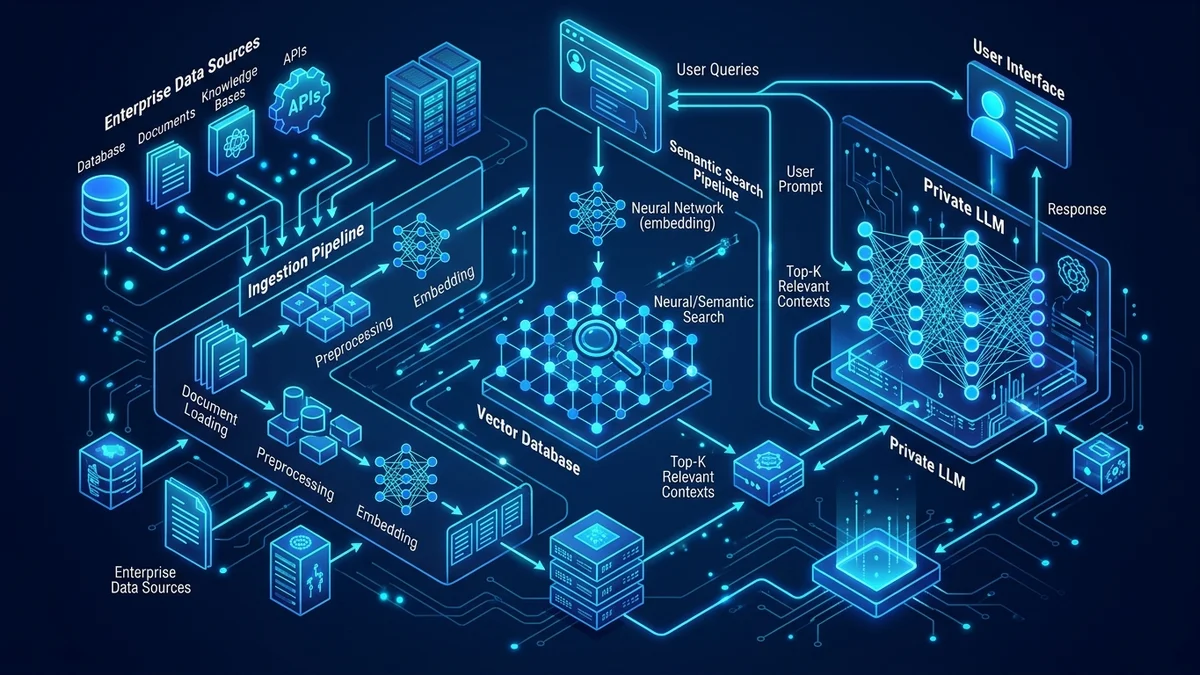
A production RAG architecture decouples knowledge storage from language reasoning through a multi-stage ingestion and retrieval flow:
[Enterprise Data Sources] ──> [Ingestion & Chunking] ──> [Embedding Model] ──> [Vector Database]
                                                                                      │
                                                                           Top-K Semantic Match
                                                                                      │
[User Query] ───────────────> [Hybrid Query Pipeline] ───────────────────────────────┼──> [Re-Ranker]
                                (Sparse + Dense)                                      │         │
                                                                                      ▼         ▼
                                                                        [Prompt Context Builder]
                                                                                      │
                                                                                      ▼
                                                                     [Private LLM Inference Engine]
                                                                           (vLLM / VPC-Isolated)
                                                                                      │
                                                                                      ▼
                                                                            [Verified Output]
1. Ingestion, Parsing, and Semantic Chunking
Raw enterprise data (PDFs, Confluence pages, Markdown, database records) cannot simply be dumped into a vector index. High-quality retrieval demands structured preprocessing:
- Recursive Character Chunking: Splitting text along logical boundaries (paragraphs, headings, code blocks) with a sliding window of 10% to 15% overlap to preserve semantic context across chunk edges.
- Metadata Enrichment: Tagging every chunk with source URI, author, timestamp, department, and role-based access control (RBAC) permissions.
- Table & Schema Extraction: Parsing tabular records into structured markdown or JSON representations so numeric data retains contextual meaning during vectorization.
2. High-Dimensional Embedding Generation
Chunks are passed through an embedding model to convert unstructured language into dense numerical vectors:
- Dense Vector Embeddings: Models like
text-embedding-3-largeor open-weights alternatives likebge-large-en-v1.5map semantic meaning into high-dimensional space (e.g., 1536 or 3072 dimensions). - Domain Adaptation: Specialized legal, financial, or medical domains require fine-tuned embedding representations to accurately separate nuanced terminology.
Vector Database Architecture: Technical Comparison
Choosing the appropriate vector database depends on scale, latency requirements, compliance constraints, and operational overhead. Below is an architectural breakdown of leading vector stores:
| Vector Store | Deployment Model | P99 Query Latency | Hybrid Search Support | Enterprise Compliance | Best Suited For |
|---|---|---|---|---|---|
| Pinecone | Fully Managed Serverless | < 25ms | Native (Dense + Sparse) | SOC 2 Type II, HIPAA eligible | Rapid time-to-market, zero DevOps maintenance |
| Qdrant | Self-Hosted (Rust) / Cloud | < 15ms | Built-in Payload Filtering | Air-gapped, GDPR, SOC 2 | High-throughput filtering, edge & VPC deployments |
| pgvector (PostgreSQL) | Relational DB Extension | < 35ms (HNSW) | SQL + pg_trgm / Full-Text | Complete ACID, existing DB compliance | Workloads combining relational data with vectors |
| Milvus / Zilliz | Distributed Kubernetes | < 20ms | Dense + Sparse capabilities | Cloud-native, multi-tenant | Billion-scale vector search, massive enterprise clusters |
Hybrid Search & Two-Stage Cross-Encoder Re-Ranking
A common pitfall in naive RAG is relying exclusively on dense vector similarity. Dense vectors excel at conceptual similarity (e.g., matching "automobile maintenance" with "car oil change"), but struggle with exact alphanumeric strings like:
- Product SKUs (
PART-9824-X) - API endpoints (
/api/v2/auth/token) - Exact acronyms and personnel names
Implementing Hybrid Search
Production systems employ Hybrid Search, combining:
- Dense Retrieval via HNSW vector index for semantic comprehension.
- Sparse Retrieval (BM25) for exact keyword and token matching.
- Reciprocal Rank Fusion (RRF) to combine and normalize rank positions from both retrieval strategies.
Cross-Encoder Second-Stage Re-Ranking
Initial hybrid retrieval typically pulls the top 25 to 50 candidates. Passing 50 chunks into the LLM context degrades reasoning and increases latency.
A lightweight Cross-Encoder re-ranker (such as Cohere Rerank or BGE-Reranker-Large) scores the exact query-document pair together, re-ordering the top 5 chunks with extreme semantic precision before they reach the language model.
Private LLM Deployment & Enterprise Governance
Routing proprietary enterprise intelligence through third-party multi-tenant APIs introduces compliance and commercial risks. Leading enterprises deploy Private LLMs inside isolated cloud infrastructure:
1. Dedicated Inference with vLLM / TensorRT-LLM
Deploying state-of-the-art open-weights models (such as Llama 3.3 70B, Mistral, or Qwen 2.5) on private GPU instances (AWS EC2 G5/P4d or GCP A2/G2) provides:
- Zero Data Retention (ZDR): Your proprietary data is never stored, logged, or used for model retraining by external vendors.
- Predictable Token Latency: Dedicated hardware eliminates multi-tenant API rate limits and token throttling during peak operational hours.
- Air-Gapped Deployment: Models run inside private VPC subnets with zero inbound or outbound internet access.
2. Document-Level Access Control (RBAC)
Enterprise RAG systems must enforce the organization's existing access permissions. If an employee queries the system about executive compensation or unreleased product designs, the retrieval pipeline must pre-filter the vector index based on the user's authenticated JSON Web Token (JWT) before calculating similarity.
Production RAG Architecture Checklist
Before releasing an enterprise AI system to internal users or commercial customers, verify the following engineering standards:
- [ ] Deterministic Sourcing: Every answer citation links directly to the source document chunk with verified page or timestamp references.
- [ ] Guardrails & Evaluation: Automated evaluation frameworks (such as RAGAS or TruLens) monitoring context relevance, faithfulness, and answer relevance.
- [ ] Fallback Triggers: Hard rules instructing the LLM to state "I do not have access to that information" rather than speculating when context retrieval score falls below threshold.
- [ ] Continuous Ingestion Sync: Event-driven CDC (Change Data Capture) pipelines that automatically re-chunk and update vector embeddings when source files are modified.
Building Your Enterprise AI Roadmap
Whether you require a dedicated RAG pipeline for internal engineering documentation or a customer-facing intelligent search engine, architectural execution defines the line between a proof of concept and a dependable enterprise asset.
Review our Discovery & Architecture Packages to scope a milestone-based build, or connect directly with XynSol solutions architects to evaluate your private LLM infrastructure.