What Is Cloud Cost Optimization and How Do Architectural Changes Lower Infrastructure Spend?
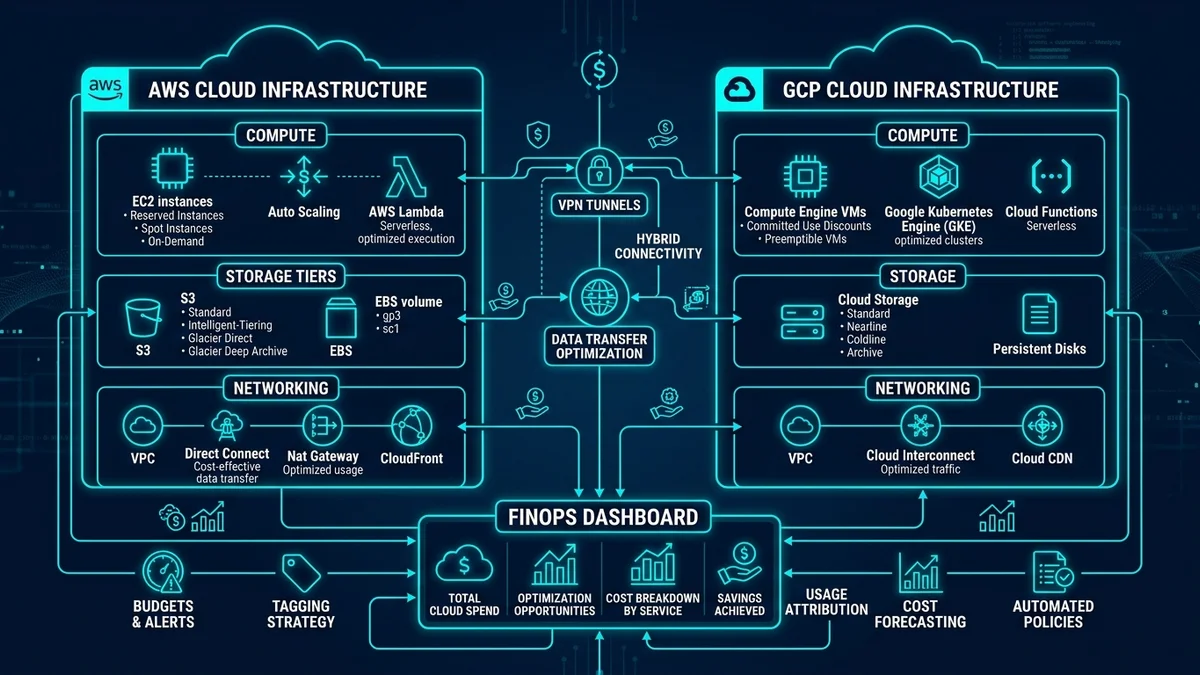
Cloud cost optimization is the systematic engineering practice of rightsizing compute resources, architecting multi-tier storage lifecycles, and eliminating networking overhead to maximize performance per dollar spent. Rather than blunt budget cuts, architectural optimization targets idle over-provisioning, inefficient cross-AZ traffic, and unoptimized serverless concurrency across AWS and GCP environments. Explore how XynSol Web & Software Engineering and DevOps & Workflow Automation audit and streamline enterprise cloud infrastructure.
In high-growth companies, cloud infrastructure bills frequently expand faster than revenue. Engineering squads focused on shipping features rapidly tend to over-provision virtual machines, leave unattached storage volumes running, and overlook cross-zone networking charges.
True cloud cost optimization (often termed FinOps) is not an accounting exercise. It is an engineering discipline that aligns system topology with actual utilization patterns without compromising availability or security SLAs.
1. Compute Layer Optimization: Rightsizing, Graviton, and Spot Orchestration
Compute typically represents the single largest infrastructure expense category of an enterprise cloud bill. Optimizing compute requires a structured approach across three tiers:
Metric-Based Rightsizing (P95 vs. Average CPU)
Standard cloud provider dashboards often report 30-day average CPU utilization. Sizing an instance based on average utilization is dangerous; it leads either to extreme over-provisioning or severe performance throttling during traffic spikes.
- Analyze P95 and P99 Metrics: Evaluate 95th percentile CPU and memory consumption over a 14-day window. If P95 CPU utilization remains consistently low during peak operating hours, evaluate downsizing the instance family.
- Memory-Bound Workloads: If memory is saturated while CPU is idle, switch from general-purpose instances (
m6i/n2-standard) to memory-optimized families (r6i/n2-highmem), reducing total instance count.
Architecture Migration to ARM (AWS Graviton / GCP Tau)
Migrating containerized microservices from legacy x86 architectures to custom ARM-based processors delivers immediate price-to-performance gains:
- AWS Graviton3 and Graviton4 (
c7g/m7g/c8g): Deliver substantially lower hourly compute costs and improved power efficiency per vCPU compared to comparable legacy x86 instance families. - GCP Tau T2A: Delivers cost-effective execution for scale-out containerized applications.
- Implementation: Because Docker and modern runtime environments (Node.js, Go, Python, Java) support multi-architecture builds, transitioning container workloads to ARM typically requires only updating the Dockerfile build matrix.
Spot & Preemptible Instance Orchestration
AWS EC2 Spot Instances and GCP Preemptible VMs utilize spare cloud capacity at discounts of up to 90% compared to on-demand rates, as documented on AWS EC2 Spot Pricing.
- Workload Eligibility: Stateless API pods, batch processing jobs, background queues, and CI/CD runner nodes are prime candidates.
- Termination Handling: Cloud providers issue a 2-minute warning (AWS) or 30-second warning (GCP) prior to reclaiming spot instances. Production clusters must deploy automated termination listeners (such as AWS Node Termination Handler) to gracefully drain traffic and reschedule pods on alternative pools.
2. Serverless Economics: Cold Starts vs. Provisioned Concurrency
Serverless execution (AWS Lambda, GCP Cloud Functions) is celebrated for its zero-cost idle state, but high-frequency production systems require careful cost modeling:
Hourly Cost
   │
   │                                  / Serverless On-Demand (High-Volume)
   │                                 /
   │                                /
   │    Crossover Point            /
   │           ▼                  /
   │           ┌─────────────────┐
   │           │ Container /     │
   │           │ ECS Fargate /   │
   │           │ Cloud Run       │
   │           └─────────────────┘
   │
└────────────────────────────────────────── Volume / Throughput- The Volume Crossover: For microservices handling continuous, steady-state traffic of several hundred requests per second, serverless invocation charges frequently exceed the cost of running containerized services on AWS ECS Fargate or GCP Cloud Run.
- Memory Calibration: Lambda charges per gigabyte-second. Over-allocating memory increases cost, but under-allocating memory can slow execution time so significantly that the total bill increases. Use tools like AWS Lambda Power Tuning to find the mathematical sweet spot.
3. Storage Lifecycle Policies and Zombie Volume Pruning
Unmanaged storage quietly accumulates compounding costs over quarters. A rigorous storage policy enforces:
Automated Object Lifecycle Management
- AWS S3 Intelligent-Tiering / GCP Autoclass: Automatically shifts objects between Frequent, Infrequent Access, and Archive tiers based on access frequency without performance penalties.
- Non-Current Version Expiration: When object versioning is enabled, overwritten or deleted files remain stored indefinitely. Configure lifecycle rules to transition non-current versions to Glacier after 30 days and permanently expire them after 90 days.
- Multipart Upload Cleanup: Failed or incomplete multipart uploads consume gigabytes of storage while remaining invisible in standard bucket listings. Apply a rule to abort incomplete multipart uploads after 7 days.
Unattached EBS / Persistent Disk Reclamation
When compute instances are terminated, attached block storage volumes frequently remain allocated. Run automated weekly lambdas or policies to identify and snapshot unattached available volumes before terminating them.
4. Network Egress and NAT Gateway Architecture
Network data transfer fees are among the most opaque items on cloud invoices:
Eliminating the NAT Gateway Tax
AWS charges $0.045 per hour per NAT Gateway plus $0.045 per gigabyte of data processed. When EC2 or container instances inside a private subnet download gigabytes of data from S3, that internal traffic routes through the NAT Gateway, generating redundant data transfer charges.
- The Solution: Deploy VPC Gateway Endpoints for Amazon S3 and DynamoDB. Gateway Endpoints are completely free and route traffic directly over the internal AWS backbone, eliminating NAT data processing fees entirely.
Multi-AZ Traffic Minimization
Data transfer between two Availability Zones in the same AWS region incurs cross-AZ charges ($0.01 per GB in each direction). Architect your load balancers and container scheduling to prioritize same-zone routing where possible.
FinOps Architectural Levers Comparison
| Architectural Lever | Target Infrastructure | Engineering Complexity | Production Risk | Typical Impact |
|---|---|---|---|---|
| Spot Instance Orchestration | Stateless APIs, Worker Queues, Batch | Medium | Low (with fallback pools) | Up to 90% discount (AWS Spot) |
| VPC Gateway Endpoints | S3, DynamoDB, Internal Services via NAT | Low | Very Low | Eliminates NAT data transfer fees |
| ARM Graviton Migration | Microservices, Web APIs, Databases | Medium | Low (requires multi-arch build) | Documented cost-per-vCPU reduction (AWS Graviton) |
| Storage Lifecycle Pruning | S3, GCS, Orphaned Disk Snapshots | Low | Zero (automated policies) | Immediate reduction in static storage spend |
| Continuous Container Transition | High-throughput serverless endpoints | Medium | Low | Prevents runaway invocation billing |
Establishing an Ongoing Cloud Optimization Framework
Cloud cost optimization is not a one-time project; without governance, infrastructure drift inevitably reintroduces waste.
- Mandatory Resource Tagging: Enforce tags for
Owner,Environment, andCostCentervia Infrastructure as Code (Terraform / Pulumi). - Automated Budget Alerts: Configure anomaly detection thresholds that notify engineering leads in Slack the moment daily spend deviates significantly from baseline.
- Dedicated Infrastructure Maintenance: Pair internal product teams with specialized cloud operations partners.
Explore our DevOps & Cloud Maintenance Retainers for proactive infrastructure monitoring, or contact XynSol's cloud engineering team to conduct a comprehensive architectural audit.