
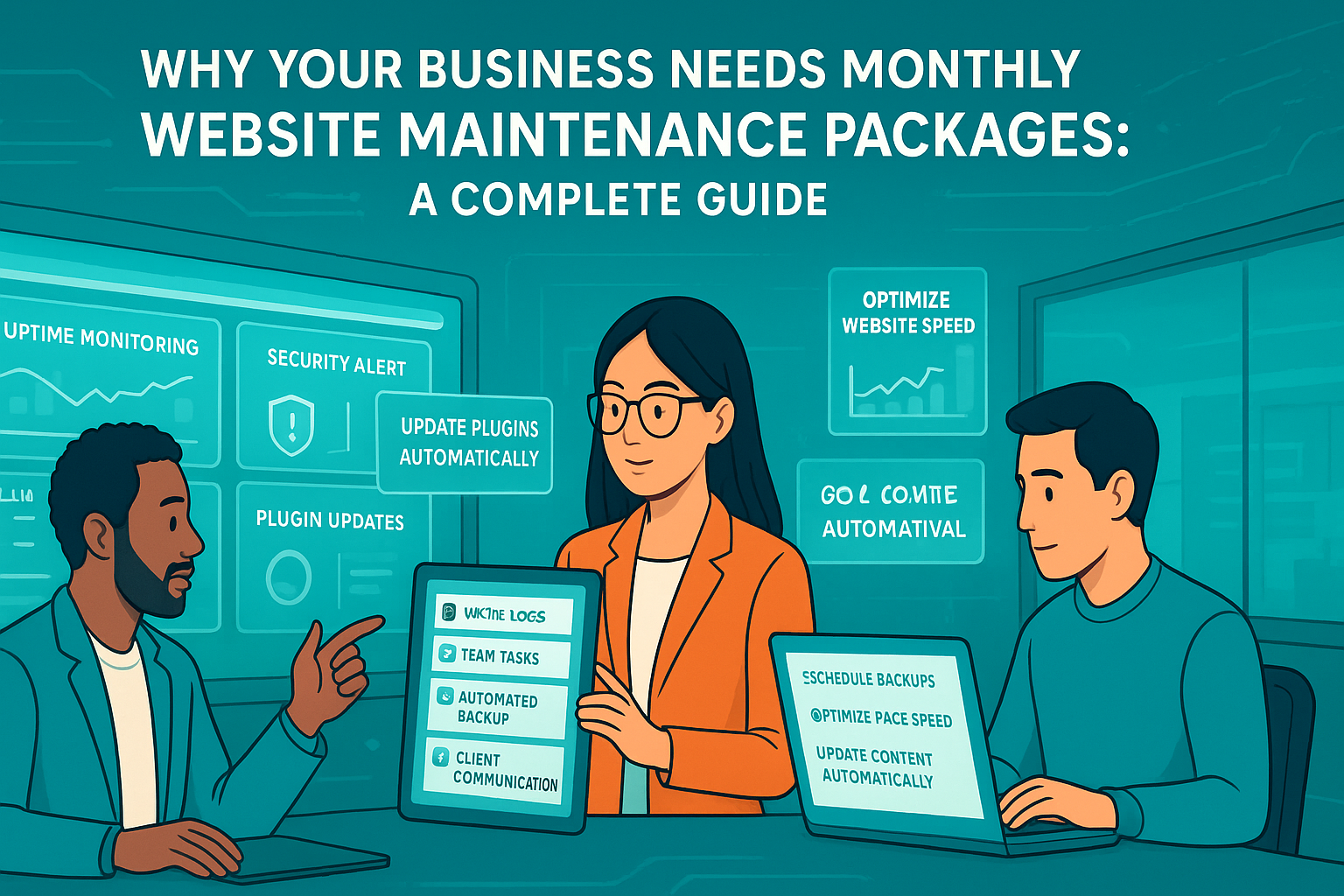
Why Your Business Needs Monthly Website Maintenance Packages: A Complete Guide
Believe that once your website goes live, it will operate itself? The majority of business owners make that error. Like your home or automobile, websites require routine maintenance. Without it, things begin to fall apart.
Here's what typically happens: You launch a gorgeous site, everything works perfectly. Fast forward six months—pages take forever to load, hackers are probing for weak spots, and suddenly a plugin update breaks your contact form. Your once-pristine investment is now costing you customers.
This happens because the web never sits still. Software updates drop constantly. Security threats evolve daily. What worked last month might fail today. That's exactly why monthly website maintenance packages exist—to handle all this chaos so you don't have to.
What Exactly Are Monthly Website Maintenance Packages?
Monthly website maintenance packages work like insurance for your site. Instead of panicking when something crashes at 2 AM and paying triple rates for emergency fixes, you've got someone already on it.
Here's the deal: these packages bundle everything your site needs. Security checks, backups, updates, speed fixes—all from one provider at one fixed price. No juggling five different specialists or wondering who to call when things go sideways.
Think of it like a gym membership. You pay monthly, use whatever you need, whenever you need it. No surprise bills.
Best part? Your maintenance provider gets to know your site inside out. They catch weird issues before they explode into expensive disasters. That relationship matters way more than you'd think—they're not starting from scratch every time you need help.
Core Services Included in Most Maintenance Packages
When you're shopping around for monthly website maintenance packages, you'll notice every company structures things differently. But some basics show up everywhere because, frankly, every website needs them.
Security monitoring comes first. Every day, many smart and automatic hacking attempts happen on your website. Someone has to watch for strange logins, bad software, and people checking for weak points. Always being in danger is not the same as being scared for no reason.
Backups cannot be compromised. Imagine losing everything in a single day—years' worth of product pages, blog entries, and customer orders. Quality packages run automatic backups daily or weekly, stored safely off-site. If disaster hits, you restore instead of rebuild.
Software updates sound boring until you skip them. Your site runs on platforms like WordPress plus dozens of plugins and themes. To address problems and remedy security flaws, each one continuously publishes updates. It takes true competence to apply these upgrades and ensure that nothing is broken.
Performance optimization keeps things fast. We're talking image compression, database cleanup, caching management, and uptime monitoring. Site speed directly impacts your Google rankings and whether visitors actually stick around. Slow sites kill conversions.
Understanding Different Tiers of Service
Most companies offering monthly website maintenance packages set up tiered plans—basic, standard, premium, whatever they call them. Knowing these levels helps you not pay too much for things you don’t need.
Basic plans include just the important things: security checks, backups, main updates, and simple monitoring. These work fine for small business sites that don't change much. You're protected but not pampered.
Mid-tier packages expand significantly. Beyond basics, you get content updates (swapping text, adding pages, changing images), plugin management, performance tuning, and faster support response. Growing businesses that need regular tweaks but not constant development usually land here.
Premium packages deliver everything. Priority support, advanced security, detailed analytics, SEO maintenance, conversion optimization, plus substantial monthly hours for custom work. E-commerce sites and businesses where the website drives serious revenue typically need this level.
The True Price of Ignoring Continual Upkeep
Some website owners are reluctant to pay for monthly maintenance packages because they believe they are superfluous. Then they get hacked, and suddenly perspective shifts dramatically.
Imagine this: Hackers put bad code on your website. Google notices and blocks your site. Visitors see scary security warnings. Your search ranking drops fast. We really need expert help to fix this. Quick repairs can cost $500 to $5,000, depending on how serious the problem is. Every hour your website is down, you lose money.
Or your site crashes because a plugin update went wrong. No recent backups, nobody knows what broke. You are rushing to get emergency help, while customers cannot reach you. Days of being down, losing lots of money, and your reputation getting hurt.
Beyond crisis scenarios, neglected sites accumulate silent problems. Slow load times frustrate visitors who leave before pages even render. Outdated content makes you look unprofessional. Security vulnerabilities sitting exposed for months create serious liability. These issues don't trigger alarms—they just quietly destroy your ROI.
How Maintenance Packages Improve Your Bottom Line
Monthly website maintenance packages cost money, obviously. But frame them as investments that generate returns multiple ways.
Prevention beats emergency repairs financially. Changing your car's oil costs way less than replacing a seized engine. Same logic applies. Maintenance packages typically run $50 to $500 monthly depending on complexity. Emergency fixes? Easily several thousand dollars.
Search engines like websites that are well taken care of. Google looks at things like user experience, security, how the site works on phones, and speed when deciding rankings. Regular maintenance optimizes these elements. Even modest ranking improvements can dramatically increase organic traffic and leads.
Operational efficiency improves too. Having a dedicated provider who knows your site intimately means changes happen fast. You're not hunting for help, explaining your setup repeatedly, or dealing with slow responses. This efficiency saves internal time and enables quicker marketing execution.
What to Look For in Quality Maintenance Providers
Not all monthly website maintenance packages deliver equal value. Choosing the right provider matters as much as the services themselves.
Response time commitments should be crystal clear in your agreement. How fast will they respond to support requests? Do emergencies get different treatment than routine stuff? Quality providers guarantee specific response windows and actually hit them consistently.
Communication style is more important than most people think. You want someone who will keep you informed in advance, explain technological concerns in simple terms, and remain reachable via the channels you really use—phone, email, help portal, whatever suits you best.
Technical expertise should go deep, not wide. Your provider needs to understand security best practices, performance optimization, and specifically the platform your site runs on. Ask about certifications, experience, specializations. A WordPress-focused provider will serve your WordPress site infinitely better than a generalist dabbling in everything.
Transparent reporting lets you see the benefits. Good service providers send regular reports about the work they’ve done, the security problems they stopped, website uptime, and how well the site is running. This shows they aren’t just taking money—they are really managing your website.
Customizing Your Maintenance Plan
Standardized monthly website maintenance packages offer convenience, but the best arrangements often involve some customization matching your specific situation.
Your website's complexity should drive your service level. A five-page brochure site needs far less maintenance than a membership platform processing payments with user-generated content and complex integrations. Be honest about your site's technical demands when choosing a tier.
Your internal capabilities matter too. If you've got a marketing team handling all content updates internally, you don't need packages with extensive content management hours. Conversely, if technical expertise is zero in-house, you'll want comprehensive coverage handling everything.
Your growth trajectory deserves consideration. Planning significant enhancements? Launching e-commerce? Scaling traffic substantially? Your maintenance needs will evolve. Many providers let you adjust packages as circumstances change, but discussing growth plans upfront positions you properly.
Common Misconceptions About Website Maintenance
Several myths about monthly website maintenance packages lead business owners into poor decisions regarding site care.
Some believe their hosting company handles maintenance. Hosting and maintenance are fundamentally different services. Hosting provides server space where your website lives. Maintenance manages the software, security, and content of your site itself. Most hosting companies offer minimal maintenance beyond keeping servers running.
Others think they can handle maintenance themselves by clicking update buttons occasionally. Basic updates might seem straightforward, but they can break functionality if plugins conflict or themes aren't compatible with new versions. Professional maintenance includes testing after updates to catch problems before visitors experience them.
There's also this idea that newer websites don't need maintenance packages. Purchasing Continued Website Maintenance
There's also this idea that newer websites don't need maintenance packages. Truth is, new websites often need more looking after than old ones. You’re still changing things, fixing random issues, and checking that all parts work fine. If you start a good care plan early, small troubles won’t turn into big headaches later.
Deciding to Invest
TTo see if a monthly maintenance plan is worth it, look at your own website. Think about what you already pay—hosting, security tools, backups, and small fixes you hire someone for. You may find that putting everything in one plan costs less and works better.
Think about what happens if something goes wrong with your site. Does it directly affect your sales? Are you storing customer information? Is your website basically your main way of reaching people? If you answered yes to any of these, even a couple hours of downtime could really hurt your business. That makes proper maintenance worth the investment.
Also, time management is not talked about enough. How many hours have you wasted trying to fix something that a professional could have done in ten minutes? That time may be used to properly run your business. Your time has value. Redirecting it from maintenance tasks to core business activities often generates returns far exceeding maintenance costs. Your time has value. Redirecting it from maintenance tasks to core business activities often generates returns far exceeding maintenance costs.
Moving Forward With Confidence
Your website is a major investment in how your business shows up online. Maintaining it on a monthly basis is merely good business, not some fancy extra. It ensures that everything functions properly, prevents issues from arising, and helps you make the most of what you've created.
It is hard to find something that works for you without spending too much money. Think about how hard your website is, how much you can do yourself, and how much tech stuff you can handle. Then look for people who know your website type, give plans that really help you, and explain things in easy words.
Here's the thing: going with the cheapest option usually backfires. You might save a few bucks upfront, but you'll pay for it later. Good maintenance from people who really know their stuff and actually care about your success is worth so much more than bare-minimum service from someone just going through the motions.
Your website works for you all day and night. It needs the same care you give to other important parts of your business. If you take care of maintenance properly, your site will run well, stay safe, and do its job for many years.