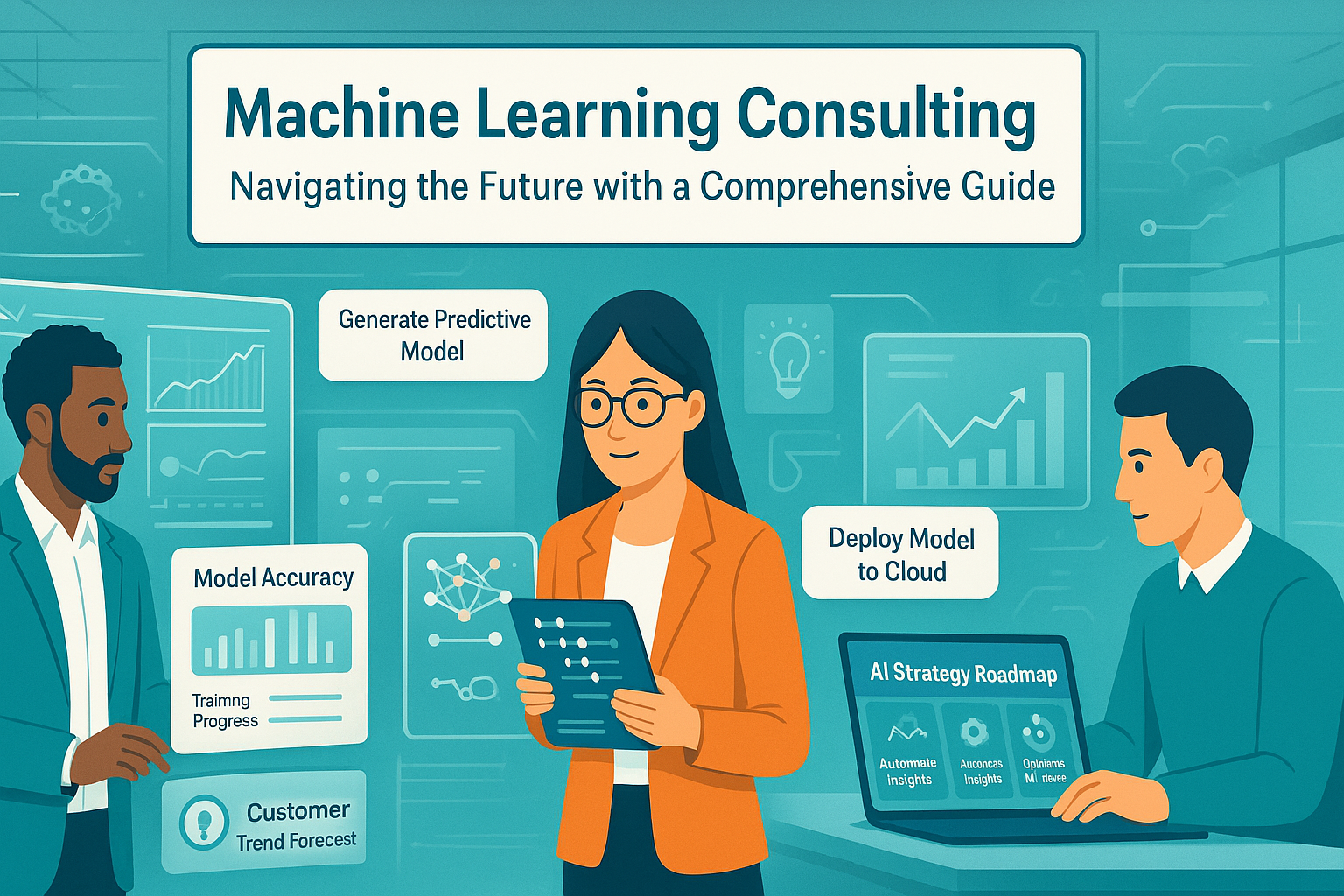
Machine Learning Consulting: Navigating the Future with a Comprehensive Guide
Staying competitive now requires artificial intelligence, and digital transformation has fundamentally altered how businesses view innovation. From being a specialized service, machine learning consulting has developed into an essential strategic tool for companies looking to take advantage of what intelligent systems can provide. The knowledge offered by skilled consulting services has grown essential as companies in all sectors struggle with ever-increasing data volumes and more complicated operational issues.
Understanding the Essence of Machine Learning Consulting
In essence, machine learning consulting is a specialist service that assists businesses in transforming AI theory into tangible commercial outcomes. These companies combine engineers, data scientists, and business strategists who understand the opportunities and challenges that each industry encounters in the real world with the ability to create sophisticated algorithms.
The consulting process covers several key areas. Consultants start by examining what a company currently has in place – their systems, how well they handle data, and what goals they're working toward. This preliminary review is important since it informs all subsequent recommendations and effort. Proficient advisors don't offer premade responses. They adapt their methods to meet the specific requirements of every client to guarantee that machine learning initiatives provide genuine business value rather than just being visually appealing technology displays.
Furthermore, the technical use of models and algorithms is only one aspect of machine learning consulting. The success or failure of AI programs is frequently determined by the organizational change management components that consultants handle. This covers the development of governance frameworks, process redesign, and workforce training to guarantee the ethical and responsible use of machine learning systems.
The Spectrum of Services Offered
Throughout the AI deployment process, a wide range of services are provided by expert machine learning consulting organizations to meet different business demands. One of the most valuable services is strategy formulation, in which consultants work with senior management to identify high-value applications and create roadmaps that are prioritized according to practicality, expected returns, and alignment with organizational goals.
Data infrastructure assessment and optimisation constitute another vital service area. Machine learning models require substantial volumes of quality data for effective performance, yet numerous organizations maintain data distributed across disparate systems, compromised by inconsistencies and quality deficiencies. Consultants look at existing data structures, suggest improvements, and frequently help build strong data frameworks that facilitate effective workflows for model training and deployment.
Model development and deployment is really the core of what machine learning consultants do. This covers everything from defining the problem and picking the right algorithm to training the model, testing it, and getting it running in production. Consultants know their way around different types of machine learning – supervised learning, unsupervised learning, reinforcement learning, and deep learning – and they choose whatever fits best for your specific situation.
Many consulting firms also offer ongoing monitoring and maintenance services. Model drift is the term used to describe how machine learning models can become less accurate over time when data patterns change. To ensure you continue to gain value out of your investment, professional consultants build up monitoring systems that keep track of how well models are working and initiate retraining when the accuracy starts to decline.
Industries Transformed Through Consulting Expertise
Machine learning consulting touches nearly every part of today's economy, though some sectors have jumped on board faster than others. Banks and financial companies hire consultants to build fraud detection systems, assess credit risks, and create trading algorithms. These systems use machine learning's capability to identify subtle patterns within massive transaction datasets that human analysts would overlook.
Healthcare represents another major adopter of these services, applying machine learning to diagnostic imaging, treatment outcome forecasting, and accelerated pharmaceutical development. Medical data poses particular complexities – merging structured electronic health records with free-form clinical documentation and sophisticated imaging information – making specialized consulting knowledge essential.
Retail and e-commerce businesses work with consultants to estimate customer behavior, optimize recommendation algorithms, and provide individualized experiences at scale. Machine learning is used in the manufacturing sector for supply chain optimization, automated quality control procedures, and predictive equipment maintenance. Because every industry has different problems and possible uses, consultants must gain deep domain knowledge that goes beyond their technical expertise.
Selecting the Proper Consulting Associate
Selecting an appropriate machine learning consultant represents a pivotal choice that substantially influences outcomes. Start by examining their technical competencies and prior achievements. Analyze their project portfolios and connect with former clients, especially those operating in comparable sectors, to gauge their capacity for execution.
But here's the thing – how well you work together matters just as much as their technical chops. You need people who operate similarly and communicate effectively because machine learning initiatives require close collaboration between your team and the consultants. The finest consultants don't just tell you what to do; they actually want to understand your business and are open to learning from the experience of your staff.
Additionally, look for transparency. From the beginning, good consulting businesses clearly define the phases of the project, what you will receive at each stage, and how success will be judged. They set reasonable expectations on what can be accomplished within your timeframe and budget, and they are forthright about the reality that not all machine learning experiments are successful.
Organisations should also assess a consultant's commitment to knowledge transfer and capability building. The most valuable consulting engagements leave client teams better equipped to manage and evolve machine learning systems independently, rather than creating perpetual dependencies on external expertise.
The Implementation Journey
Most machine learning consulting engagements follow a methodical yet adaptable framework. Stakeholder engagements, data asset exploration, and a realistic assessment of what is feasible are all part of the first discovery step. Consultants look at organizational preparation factors such leadership buy-in, data management maturity, and available computer resources in addition to technical issues.
Following discovery, consultants create a thorough project charter that includes objectives, constraints, methods, schedules, and resource needs. This document facilitates scope administration and progress tracking by acting as the engagement's guiding structure.
The development stage involves data conditioning, engineering relevant features, experimenting with various models, and progressive refinement. Skilled consultants sustain ongoing stakeholder engagement throughout this phase, sharing intermediate discoveries and adapting their methods as new information surfaces. This iterative exchange keeps the technical work tethered to business imperatives.
Deployment is where consulting expertise really shows its worth. Consultants oversee the intricate processes of setting up frameworks for performance monitoring, integrating models into current operating environments, and putting backup plans in place in case of emergencies.
Following deployment, there is usually a transition period where consultants assist internal teams in taking on operating duties. Documentation creation, training sessions, and a progressive turnover of responsibilities are all included in this knowledge transfer.
Return on Investment Metrics
Choosing suitable metrics that capture both measurable and intangible advantages is necessary for assessing the results of machine learning consulting projects. Revenue increase through greater suggestion skills, cost reductions through operational optimization, or loss avoidance through improved fraud detection methods are examples of tangible financial consequences.
However, the complete value proposition frequently extends beyond immediate financial quantification. Strategic benefits including enhanced organizational agility, quicker decision-making, and better customer experiences, are regularly produced by machine learning projects. Smart companies look at their machine learning investments through this wider angle, understanding that gaining a competitive edge might matter more than immediate financial returns.
Additionally, successful engagements build internal capabilities that compound over time. Teams that work alongside skilled consultants develop deeper understanding of machine learning principles and practices, enabling them to identify and pursue additional opportunities independently. This capability development represents a form of organisational capital that appreciates long after formal consulting engagements conclude.
Looking Forward
As business applications and technological capabilities develop in tandem, the machine learning consulting landscape continues to rapidly change. New methods like edge computing, federated learning, and automated machine learning broaden the range of services consultants may provide to businesses while also increasing the need for specialized technical know-how.
The consultancy value proposition changes as machine learning becomes more widely available through improved tools and platforms. Model development becomes less important in favor of organizational change management, strategic direction, and solving complex problems that defy easy fixes. Consulting practices that effectively guide organizations through substantial operational and organizational transformations driven by AI technologies are those that maintain equilibrium between technical proficiency and commercial insight.
Collaborating with experienced consultants markedly expedites progress, averts expensive errors, and establishes robust foundations for sustained AI-powered innovation among enterprises pursuing machine learning adoption. In an economy that is becoming more and more dependent on artificial intelligence, investing in professional experience creates value through improved implementations, enhanced internal capabilities, and improved competitive positioning.