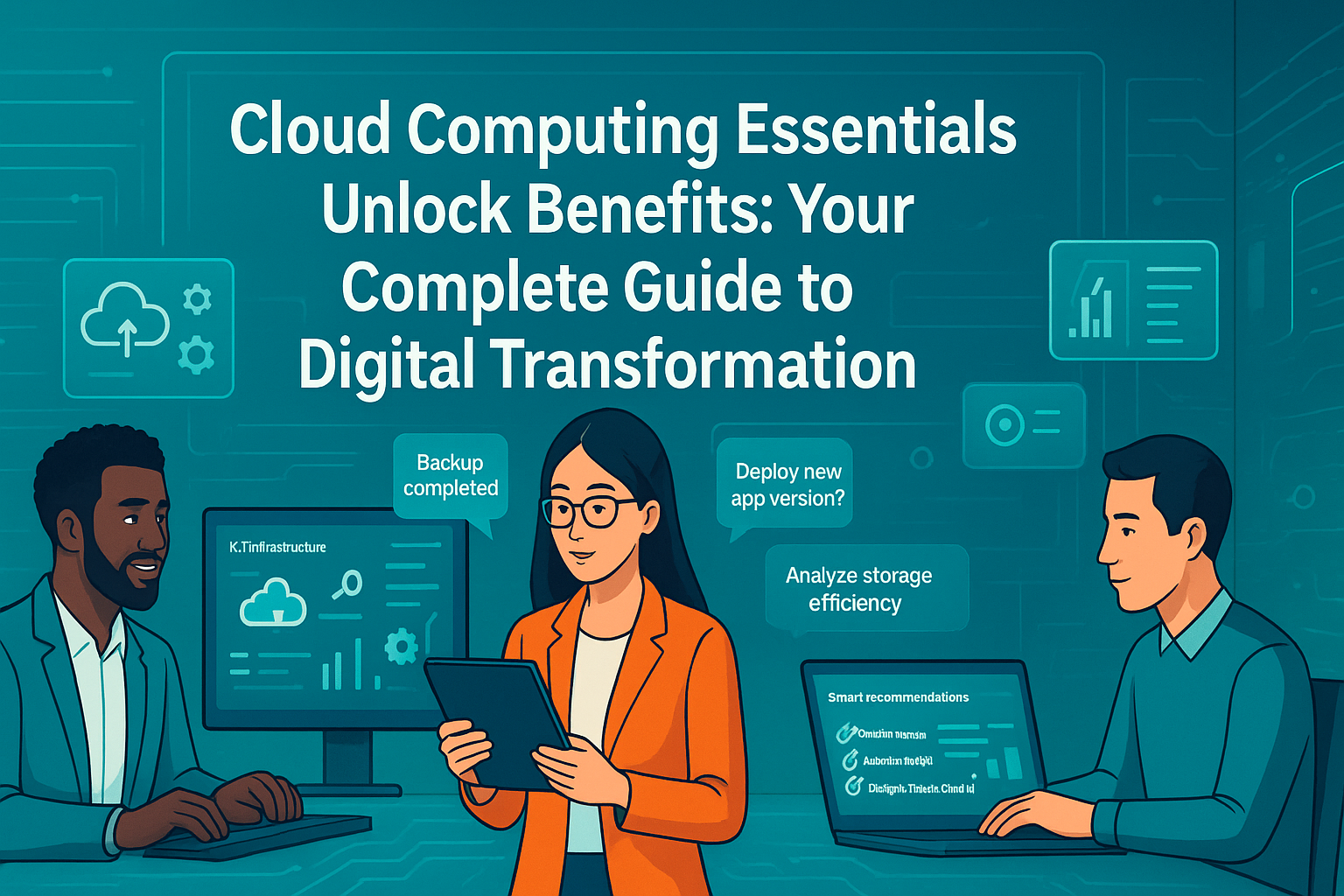
Cloud Computing Essentials Unlock Benefits: Your Complete Guide to Digital Transformation
The technologies that organizations now rely on have brought about significant change in the digital world during the past ten years. Regardless of the size of your business, understanding the fundamentals of cloud computing can determine whether it remains competitive or lags behind.
IT expenses used to overwhelm my friend Sarah, who owns a small marketing company. Her team was unable to work together efficiently when working remotely, her servers were continuously at capacity, and maintenance was taking a large portion of her budget. Everything changed when she realized the potential of cloud computing. Millions of businesses are going through similar changes, therefore her experience is not unusual.
What Makes Cloud Technology Essential Today?
Cloud computing has evolved significantly. What began as simple storage has grown into full business infrastructure delivered over the internet. The concept is straightforward: you only pay for the program, server, or database that you use.
Such as Uber, without a car. You go; you don't have to worry about parking, fixing, or insurance.
Pandemics change quickly. Cloud-based work from home is already used by the company. Other businesses adapt quickly.
IaaS provides infrastructure, PaaS provides software development tools, and SaaS provides ready-to-use applications. Help businesses operate on a daily basis.
Cost Efficiency: The Financial Game-Changer
Let's discuss costs, since that's usually the first concern for business owners. Traditional IT infrastructure demands major upfront investment - servers, data centers, IT staff, constant equipment upgrades. It's like buying a full restaurant kitchen when you just want to cook dinner once in a while.
The way cloud computing essentials unlock benefits directly impacts your bottom line in measurable ways. First, you eliminate capital expenses and shift to an operational expense model. Instead of spending $50,000 on servers that might be obsolete in three years, you pay monthly for exactly what you need. When Sarah moved her agency to the cloud, she cut her IT costs by 40% in the first year alone.
You don't have to pay for idle capacity when you use the pay-as-you-go strategy. Your expenses naturally drop during calm times. Scaling up during busy periods doesn't require buying new equipment. This flexibility is perfect for businesses with fluctuating demand - like online retailers during holiday shopping or tax services during filing season.
You also cut costs on physical space, electricity, and cooling systems. Cloud providers handle the massive power requirements of data centers, not you. To help your organization run more responsibly, major cloud providers also use a lot of renewable energy.
Scalability and Growth Made Simple
Instagram attracted 25,000 users on its first day. Their early success may have been lost if traditional servers had crashed under that demand. But Instagram ran on cloud infrastructure, letting them scale instantly to handle the traffic.
This shows what cloud computing offers that traditional systems can't. Scalability isn't just about growth - it's about adapting in real time. Need extra storage for a campaign launch? It's available in minutes, not weeks. Launching a new product line? Spin up additional servers without calling your IT department.
The flexibility extends beyond just computing power. Cloud platforms offer a buffet of services you can mix and match according to your needs. Want to add artificial intelligence capabilities to your customer service? There's a cloud service for that. Need advanced analytics on your sales data? Enable it with a few clicks.
For seasonal businesses, this flexibility is transformative. A tax preparation firm doesn't need year-round capacity for their peak season in March and April. With cloud services, they can scale up during tax season and scale back down afterward, paying only for what they actually use. This type of flexibility was not possible with traditional infrastructure since it had to be constructed for peak capacity and wasted resources during slack periods.
Improved Resources for Collaboration and Remote Work
The workplace of today differs greatly from that of a decade ago. Distributed teams, remote work, and hybrid configurations are no more uncommon. This is another area where cloud computing essentials unlock benefits that have become absolutely critical for business success.
No matter where they are, teams may collaborate on the same documents at the same time using cloud collaboration technologies. In real time, engineers in San Francisco can collaborate with designers in Berlin and marketers in Singapore. Version control issues become obsolete when everyone's working from the same cloud-based source of truth.
Sarah's marketing agency discovered this benefit immediately. Her team could access client files, project management tools, and creative assets from anywhere. A designer working from a coffee shop had the same access as someone in the office.
Client presentation can be altered a few minutes before the meeting, and everyone sees change fast. Cloud platforms facilitate team collaboration, file sharing, project management, and video calls seamlessly. There's no confusion about which version is current or who has the most recent updates. With cloud tools, teams stay connected and work efficiently from any location.
Security and Disaster Recovery: Sleep Better at Night
Here's where many business owners get nervous. Isn't putting my data "out there" on the internet less secure than keeping it in-house? The reality is the opposite, and this is one of cloud computing's biggest advantages for businesses of any size.
Major cloud providers spend billions on security - far beyond what most companies could afford alone. Cloud providers employ security specialists, adhere to strict standards, and use advanced encryption to protect data. Cloud storage is typically more secure than office servers.
Consider the risks facing office servers: theft, fire or water damage, and power outages. Because cloud companies have multiple data centers spread across multiple places, your data is more dependable and safe. If one facility has issues, your data is automatically served from another location. This redundancy is prohibitively expensive for most businesses to implement on their own.
Disaster recovery is very beneficial. When Hurricane Sandy hit New York in 2012, cloud-based businesses were back up within a few hours. Do business with a server that is submerged? Some never get back to work. Many copies of data are saved in the cloud, and they can be restored at any time in case of issues.
Regular security updates and patches are handled automatically by cloud providers. You don't need to worry about whether your security software is up to date—it's managed professionally as part of the service. For small businesses without dedicated IT security staff, this is invaluable protection.
Innovation and Competitive Advantage
Basic cloud computing makes new ideas happen much faster. Things that used to take months or years are now finished in a matter of days or hours. Cloud speed enables businesses to test new concepts, create products, and swiftly adjust to changes in the market.
Think about machine learning and artificial intelligence. Most firms cannot afford to maintain these technologies in their own facilities since they require a lot of computing power. Cloud platforms facilitate the usage of new technology by providing these tools as services. The technologies that were previously exclusive to large IT corporations are now available to small businesses.
Development teams can easily establish up test environments, explore new ideas, and stop them if they don't work without spending a lot of money. This "fail quickly, learn quicker" strategy promotes creativity and lowers the cost of experimentation. Businesses can simultaneously perform several tests and concentrate resources on the successful ones.
This creates a real competitive advantage. Cloud computing speeds up corporate operations. They can easily enter new markets, listen to customers quickly, and create new products quickly.
Automatically Update and Repair
Nobody likes dealing with system updates on a Sunday at two in the morning. The way cloud computing essentials unlock benefits in terms of maintenance and updates alone justifies the switch for many IT professionals. The challenging jobs are handled by cloud providers; security patches, software updates, hardware maintenance, and system updates all occur automatically in the background.
Your IT staff (or you, if you oversee IT) will save time and effort by doing this, allowing you to concentrate on more significant objectives rather than merely maintaining operations. Your team can focus on projects that advance your company's growth instead of putting in hours installing updates and checking patches. The opportunity cost of traditional IT maintenance is enormous when you calculate the hours spent on routine upkeep.
Cloud providers typically guarantee uptime of 99.9% or higher, backed by service level agreements. If they fail to meet these standards, you receive credits or refunds. Try getting that guarantee from your in-house server setup. The responsibility for reliability shifts from you to the provider, along with the resources to ensure that reliability.
Environmental Impact
Cloud computing offers real environmental benefits that matter to both businesses and customers. It helps reduce carbon footprints while meeting sustainability targets.
Cloud providers operate at a scale individual companies can't match. Their data centers run on optimized energy systems, often using renewable power. Major providers have set ambitious goals - some are already carbon neutral, others are targeting it within the next few years.
Using cloud services means sharing infrastructure with thousands of other organizations. This shared approach is far more efficient than each company running separate servers. Think carpooling versus solo driving - same destination, much smaller environmental impact.
Lower energy use means reduced costs and emissions. For companies pursuing sustainability, moving to the cloud often delivers the biggest single reduction in IT-related carbon output. Some organizations have cut their IT emissions by over 90%.
Taking the First Steps
Understanding the benefits is easy. Acting on them takes planning. You don't need to move everything overnight. Most businesses start with a hybrid model - shifting some operations to the cloud while keeping others local temporarily.
Start by identifying your biggest pain points. Is it storage costs? Collaboration challenges? Disaster recovery concerns? Prioritize what produces quick results because different cloud services address different issues. Start with simple solutions like cooperation tools and file storage, then gradually proceed to more complex ones.
Choose a supplier that meets your needs. While some smaller providers concentrate on particular industries, AWS, Azure, and Google Cloud are effective for the majority of organizations. Consider the regulations you need to go by, the location of your data storage, and the degree to which the services integrate with your existing systems.
Training matters most. Technology isn't the barrier to cloud adoption - people are. Get your team comfortable with new tools and processes. It pays off when they actually use these platforms effectively instead of treating them like expensive filing cabinets.
Moving Forward
The debate about whether cloud computing benefits businesses is over - it clearly does. The real question is how fast you'll adopt it to stay competitive.
The advantages touch everything: lower costs, easy scaling, better security, reduced environmental impact. Companies using cloud technology set themselves up for growth and flexibility. Those avoiding it risk falling behind faster competitors.
Cloud is helpful for most businesses, but it's not ideal for everyone. The cloud will be increasingly helpful as technology advances. The companies succeeding in five years will be the ones making the switch now.